
Microeconomics
The focus of this web page is to help students develop a better understanding of the various market forces at work in our economy. A primer is included on the basics of demand and supply - both essential concepts in developing a sound understanding of micro and macroeconomics. If you are having difficulty working with demand and supply curves, study and review the information below.
Law of Demand Explained
Observe this video for an explantion of why the demand curve is negatively sloped due to the income and substitution effects and diminishing marginal utility.
Demand and Supply Concepts
Change In Demand (Shifts in Demand)
Means that a greater or lesser number of units is bought without changing price. This means a shift in the demand curve. If it shifts up and to the right, a greater number of units is demanded at any given price. If it shifts down and to the left, a lesser number of units is demanded at any given price. Click here for an excellent video overview!
Change in Quantity Demanded
Means that a greater or lesser number of units is bought because of a change in price. An increase in quantity demanded means that a greater number of units is bought because the price has been lowered. We are moving down a particular demand curve. A decrease in quantity demanded means that a lesser number of units is bought because the price has been raised. We are moving up a particular demand curve.
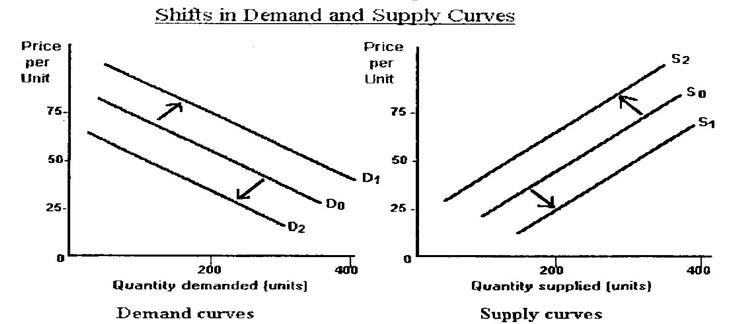
Change in Supply (Shifts in Supply)
Means that a greater or lesser number of units is supplied without changing price. This means a shift in the supply curve. If it shifts up and to the left, a lesser number of units is supplied at any given price. If it shifts down and to the right, a greater number of units is supplied at any given price. Click here for an excellent video overview!
Change in Quantity Supplied
Means that a greater or lesser number of units is supplied because of a change in price. An increase in quantity supplied means that a greater number of units is supplied because the price has been raised. We are moving up a particular supply curve. A decrease in quantity supplied means that a lesser number of units is supplied because the price has been lowered. We are moving down a particular supply curve.
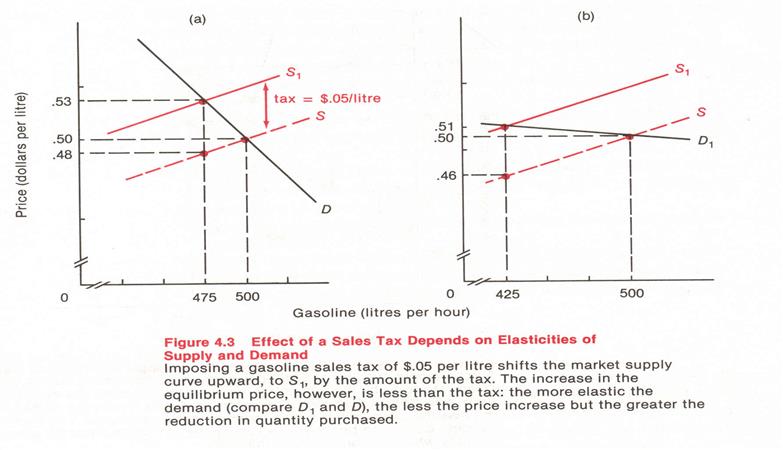
Source: Stager, D., Economic Analysis and Canadian Policy, 7th ed., Toronto: Butterworths, 1992.
Indirect Taxes and the Impact on the Market Place: Elasticity of Demand and Sales Tax
Effects of Indirect Taxes
View the presentation at the link below to gain a better understanding of the types of taxes used by governments and the relative impact on the market, depending on elasticity of demand.
Understanding Elasticity
Understanding the responsiveness of quantity demanded to changes in price is critical for consumers and businesses. Price elasticity of demand is an essential concept in microeconomics. Observe the following videos for a quick overview.
(focuses on calcluation & interpretation of Ped coefficient - Gr 12 SL/HL )
(focuses on interpretation of Ped and TR relationship - Gr. 11 pre-IB)
Consumer, Producer & Social (Community) Surplus
Understanding the effects of government intervention in the market place involves examining the impact on price, resource allocation and consumer/producer/social surplus. Observe the videos below for a review of the effects of government inetrevention in the form of taxes, subsidies and price controls.

Practice Your Demand and Supply Skills!
Ready to review and practice your knowledge of markets and how changes in demand and supply affect equilibrium price and quantity? Observe this video and try the practice questions provided half way through the video. Be sure to pause the video and use a diagram to answer each of the scenarios given related to the 'fidget spinner' market. Good luck!