
Many important people have contributed to the field of economics. As one of the required term assignments, this part of the site provides resources and information concerning the lives and work of some of the more important economists. Below you'll find a brief background of some of the more important economists' life/times and some associated links to get you started on your research. Don't forget to use print sources also while conducting your research.
John Maynard Keynes
Background:
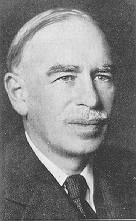
John Maynard Keynes was born into economics. His father, John Neville Keynes, was a lecturer in economics and logic at Cambridge University. John Maynard began his own studies at Cambridge with an emphasis on mathematics and philosophy. His abilities soon so impressed Alfred Marshall, however, that the distinguished teacher urged him to concentrate on economics. In 1908, after Keynes had finished his studies and done a brief stint in the civil service, Marshall offered him a lectureship in economics at Cambridge, which he accepted.
Keynes is remembered above all for his General Theory of Employment, Interest, and Money, published in 1936, although that was by no means his first important work. Keynes's reputation as the outstanding economist of his generation lay in the departure from classical and neo-classical theory he made there. It is hardly necessary to say much about the substance of the General Theory in these paragraphs, because they are extensively discussed in every modern textbook on economics. It will be enough to note that its major features are a theory boldly drawn in terms of broad macroeconomic aggregates and a policy position tending toward activism and interventionism.
Keynes was no "narrow" economist. He was an honoured member not only of the British academic upper class but also of Britain's highest financial, political, diplomatic, administrative, and even artistic circles. He was intimately involved with the colourful "Bloomsbury set" of London’s library-Bohemian world. He was a friend of Virginia Woolf, E. M. Forster, and Lytton Strachey; and in 1925, he married ballerina Lydia Lopokovia. He was a dazzling success at whatever he turned his hand to, from mountain climbing to financial speculation. As a speculator, he made an enormous fortune for himself, and as bursar of Kings College, he turned an endowment of 30,000 pounds into one of 380,000 pounds.
Keynes had a profound and direct impact on economic policymaking in Canada. A number of Canadian economists worked with or studied under him, before and during World War II. One of them, W. A Mackintosh, who during the war was Director General of Economic Research in the Department of Reconstruction and Supply in the Canadian government, and later became Principal of Oueen's University, wrote a government White Paper on Employment and Income in 1945 that was based on Keynesian ideas. Mackintosh said of that document: "Though the battle over Keynesianism had been pretty well conceded, I had some interest in seeing how far some of the elements of Keynesianism could be presented as the most ordinary of common sense." This White Paper was one of the first commitments by any government to a high employment policy.
Source: Dolan & Vogt, Basic Economics, 2'nd ed., HRW, 1984.
Milton Friedman
Background:
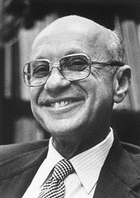
In October 1976, Milton Friedman received the Nobel Memorial Prize in economics, becoming the sixth American to win or share in that prize. Few were surprised. The main surprise was that this most original and influential of economists had had to wait in line so long! The explanation is that Friedman has built his career outside the economics establishment - built it, in fact, by challenging virtually every major establishment doctrine.
Friedman was born in New York in 1912, the son of immigrant garment workers. His hard-working parents sent him across the river to Rutgers University in New Jersey, where Friedman came under the influence of Arthur Burns, then a young assistant professor. From Burns, Friedman learned the importance of empirical work in economics. Statistical testing of all theory and policy prescriptions became a key characteristic of Friedman's later work. From Rutgers, Friedman went to the University of Chicago for an M.A. and then east again to Columbia University, where he got his Ph.D. in 1946. With his degree in hand, he returned to Chicago to teach. There, he became the leading member of the "Chicago School," which provides the main intellectual counterweight to the Eastern Establishment in U.S. economics today
If one were to single out the theme that underlies all of Friedman's work, it would be his conviction that the market economy works - and works best when left alone. This can be seen in his best-known work, A Monetary History of the United States. Written with Anna Schwartz, the work challenges two major tenets of orthodox Keynesian economics: first, the idea that the market economy is inherently unstable without the guiding hand of government, and second, that monetary policy had been tried and found useless as a cure for the Great Depression. Friedman and Schwartz found both beliefs to be the opposite of the truth. "The Great Depression," Friedman later wrote, "far from being a sign of the inherent instability of the private enterprise system, is a testament to how much harm can be done by mistakes on the part of a few men when they wield vast power over the monetary system of the country."
Friedman strongly favours a hands-off policy by governments in almost every area, not just in monetary matters. The trouble, in his view, is not that government is evil by nature but rather that so many policies end up having the opposite of their intended effects. "The social reformers who seek through politics to do nothing but serve the public interest invariably end up serving some private interest that was no part of their intention to serve. They are led by an invisible hand to serve a private interest." Transport regulation, the income tax, public education, agricultural subsidies and housing programs are among the many policy areas where Friedman believes the government has done more harm than good and where a free competitive market would do better
Karl Marx
Background:
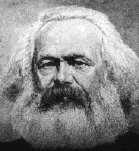
Karl Marx - German philosopher, international revolutionary, and patron saint of Soviet communism - was also a prominent member of the British classical school of economics. His study of economics began in earnest when he moved to London in 1849 at the age of thirty-one. As it was for his contemporary, John Stuart Mill, the study of economics for Marx was first and foremost the study of the works of David Ricardo. But whereas other economists of the classical school were for the most part sympathetic to the capitalist system, Marx took the tools of Ricardian economic analysis ant turned them against the social system that had spawned them.
The keystone of classical economics was the labour theory of value - the doctrine that the values and relative prices of various goods are determined primarily by the number of labour hours that go into their production. For Ricardo, the labour theory had been just a description of how the economy worked; but Marx went on to argue that if labour is the source of all value, workers ought to receive the whole product of their labour. Instead, under capitalism, a large part of that product was siphoned oft into the pockets of capitalists in the form of profits or "surplus value."
Marx did not limit himself to exposing the inner workings of the capitalist system and condemning it as unjust. In addition, he attempted in his massive work, Capital, to prove that capitalism was headed for an inevitable breakdown, to be followed by a socialist revolution. Marx worked all his life with international revolutionary groups to prepare the way for this coming revolution.
Despite his faith in the inevitability of the socialist revolution, Marx had practically nothing to say about the operation of a socialist economy. The few remarks he did make suggest, however, that the socialism he envisioned would be of a centralised variety in which the "planning principle"' would replace the "anarchy of the market". The rest he left to be worked out by future socialists in the course of their practical experience.
John Kenneth
Galbraith
Background:
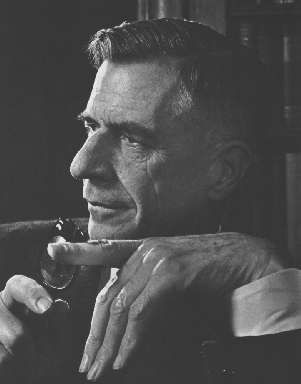
John Kenneth Galbraith, a native Canadian who has been teaching economics at Harvard University in Boston for many years, enjoys a unique distinction among economists today: his books regularly hit the best-seller list and stay there for long periods. Galbraith represents the opposite extreme from economists who, like Paul Samuelson, write primarily to gain the applause of other economists. On the Contrary his major books - The Affluent Society (1958, and The New Industrial State (1967) - are all-out attacks on conventional economics, written to be read by the widest possible non-professional audience.
Galbraith lumps everything he dislikes about modern economies under the heading of "the conventional wisdom." By this phrase, he means all the ideas that he claims are widely believed not because they are true but simply because they are often repeated. He saves his sharpest barbs for two particular elements of the conventional wisdom: consumer sovereignty and the law of supply and demand.
Consumers are not sovereign, Galbraith says, because their tastes and preferences are heavily manipulated by advertising. The ability of business to manipulate consumers knocks the "demand" leg out from under supply and demand theory. The "supply" leg is then knocked out with a second deftly aimed kick. The supply curve is valid only in an economy where firms aim to maximize profits. In the U.S. economy, says Galbraith, firms do not do this. How, then, can supply and demand determine price? The kinds of goods that consumers are persuaded to buy and the prices at which these goods are sold are determined by the whims of the "technostructure," Galbraith’s name for the managerial-professional-academic elite who run the country.
Galbraith is many things other than an economist. He is a political activist. always promoting liberal and ultraliberal causes. He served as chairman of the Americans for Democratic Action, and he played a key role in securing the Democratic presidential nomination for George McGovern. He is also a diplomat and served as John Kennedy’s ambassador to India. (At six feet eight inches, he towered almost comically over his local diplomatic counterparts there.) He once even turned his hand to writing a novel, The Triumph.
Few economists take the complete Galbraithian system seriously, but many admit that he is a useful critic. Economics, like other social science disciplines, is in fact always in danger of becoming excessively abstract and formalistic. Economists who talk only to other economists, and then only in mathematical language, do indeed often end up saying things that are just plain silly. Galbraith is determined that they not get away with it.


Resources
Below, is a brief list of links to help get you started on the important contributions of famous economists that helped shape our modern world.



Group Presentations - Famous Economists (HL Economics)
Check here for summary notes of the economists presented in class. These study notes should be used to help you prepare for any evaluation covering the ideas and theories of the economists presented in class.
